
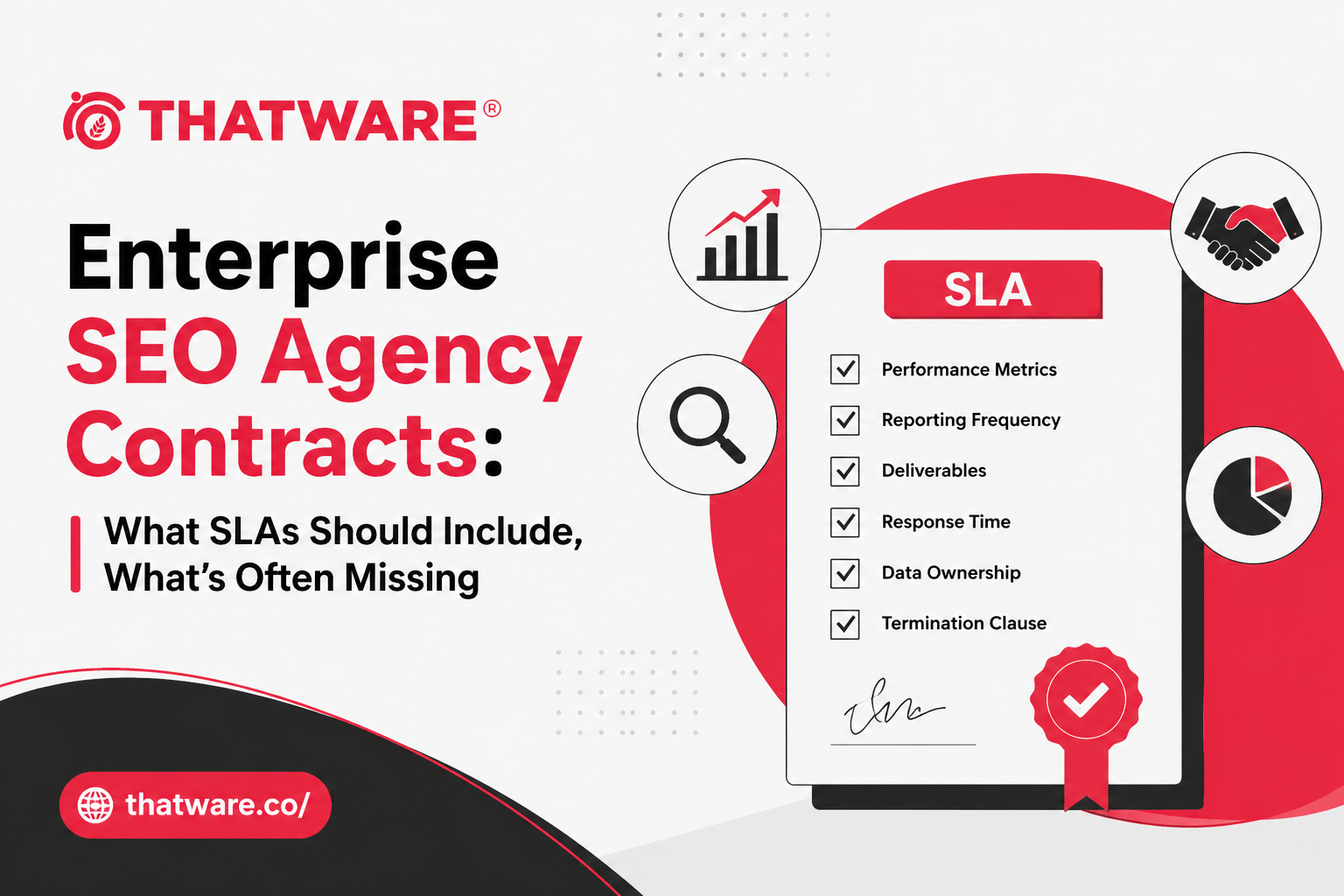
The contract negotiation phase of an enterprise SEO agency relationship is where the actual terms of accountability get established, and it’s where many clients give away more leverage than they realize. The agency has negotiated many of these contracts. The client, often, has not. The result is agreements that are sometimes comprehensive in their documentation of what the agency will do but thin on what happens if the work doesn’t produce the expected results.
This is not necessarily bad faith on the agency’s part. It’s partly the inherent difficulty of guaranteeing outcomes in a discipline that depends on search engines no one controls. But it’s also worth being deliberate about what good enterprise SEO SLAs should contain, so you know what to push for.
What Most Enterprise SEO Contracts Get Right
The deliverable scope is usually well-defined in professional agency contracts. Monthly technical audits, content production quotas, link building activity targets, reporting cadences. These are the inputs the agency commits to providing, and they’re typically specified clearly enough to know whether the agency is delivering what it promised.
Communication protocols are often covered reasonably well. Account manager contact details, escalation paths, meeting schedules, response time commitments for routine versus urgent communication. These operational details matter for day-to-day relationship management and most professional agencies have standard language that covers them.
Ownership of work product is usually addressed, confirming that content created, technical documentation produced, and strategic recommendations developed during the engagement belong to the client rather than the agency. This matters for continuity if the relationship ends.
What’s Often Missing or Underspecified
Outcome-oriented commitments are the biggest gap in most enterprise SEO contracts. Agencies are understandably reluctant to commit to specific ranking outcomes because rankings depend on factors outside their control. But the complete absence of performance commitments leaves clients with no contractual basis for holding the agency accountable to business results.
Better contracts find middle ground. Not “we guarantee position one for these keywords” but “we commit to delivering measurable organic traffic growth of X% over twelve months for priority keyword clusters” or “we commit to improving conversion rate from organic traffic by Y% within the measurement period.” These are directional commitments that allow for market variability while establishing some basis for performance evaluation.
Enterprise seo agency relationships benefit from clear agreement on what measurement framework will be used to evaluate success before the engagement begins, not after. Disputes about whether the work succeeded are much harder to resolve when the success criteria weren’t defined upfront.
Reporting standards are often underspecified. What exactly will be reported, at what frequency, in what format, and with what level of attribution to agency activity versus market-wide changes? Contracts that leave this vague produce reporting that agencies calibrate toward making themselves look good rather than giving clients the clearest possible picture of what’s happening.
The SLA Elements Worth Negotiating
A few specific SLA elements make meaningful differences in enterprise SEO relationships.
Response time commitments with differentiation between routine and urgent communication. “We respond within 48 hours” is inadequate when a site migration goes wrong or a major algorithm update causes significant traffic loss. Urgent response commitments of 4-8 hours for defined critical situations protect the client’s ability to respond quickly when it matters.
Escalation paths to senior staff should be explicitly defined. Large agency relationships sometimes experience a quality dilution over time as senior talent moves to new business and junior team members absorb the ongoing work. Contracts that specify which seniority level of staff handles which types of work, with client rights to request senior involvement for defined situations, create accountability for consistent quality.
Data ownership and portability provisions ensure that keyword ranking history, analytics data, content assets, and strategic documentation are available to the client in portable formats if the relationship ends. Agencies that make it difficult to leave by controlling data are not operating in good faith.
Enterprise seo services contracts should specify minimum notice periods for team changes on the account, particularly for the lead strategist. Continuity of the people who understand the account history is genuinely valuable and worth protecting contractually.
Termination and Performance Conditions
Enterprise SEO contracts often have long minimum terms, twelve or twenty-four months being common. This is not unreasonable given that meaningful organic results take time to develop. But long terms without performance conditions or exit provisions for sustained underperformance expose clients to significant risk.
Reasonable contract language includes provisions that allow for exit without full penalty if defined performance metrics are consistently missed over a sustained period. What counts as underperformance, measured by what metrics, over what timeframe, and what notice and cure period the agency gets before exit provisions activate, are all negotiable elements.
Agencies confident in their work should be willing to include reasonable performance conditions in their contracts. Resistance to any performance accountability is a signal worth paying attention to during negotiations.
The Negotiation Posture
Enterprise clients have more negotiating leverage than they often use. Large contracts with significant monthly retainer values are important to agencies, and professional agency relationships accommodate reasonable client requests during negotiation.
Approach the contract as a partnership framework that should protect both parties. The agency needs protection from being held accountable for factors outside its control. The client needs protection from paying for activity without accountability for outcomes. Both of these are legitimate interests that a well-negotiated contract can serve simultaneously.
The time to establish clear accountability terms is before the engagement begins, not after the first disappointing results report.